R&D Tax Relief After the Merged Scheme: Is Your SME Still Eligible or Leaving Money on the Table?

Table of Contents
The R&D tax rules changed in April 2024. That has left some SME directors with a simple question: can an SME still claim R&D tax relief after April 2024?
Yes, potentially, under the R&D tax relief merged scheme.
The old SME and RDEC schemes were replaced for accounting periods beginning on or after 1 April 2024. The merged R&D expenditure credit now applies, while Enhanced R&D Intensive Support (ERIS) remains available to qualifying loss-making, R&D-intensive SMEs.
The change did not make R&D relief disappear. It changed how qualifying companies claim it.
What is the R&D tax relief merged scheme?
The R&D tax relief merged scheme is the main R&D relief for eligible companies with accounting periods beginning on or after 1 April 2024.
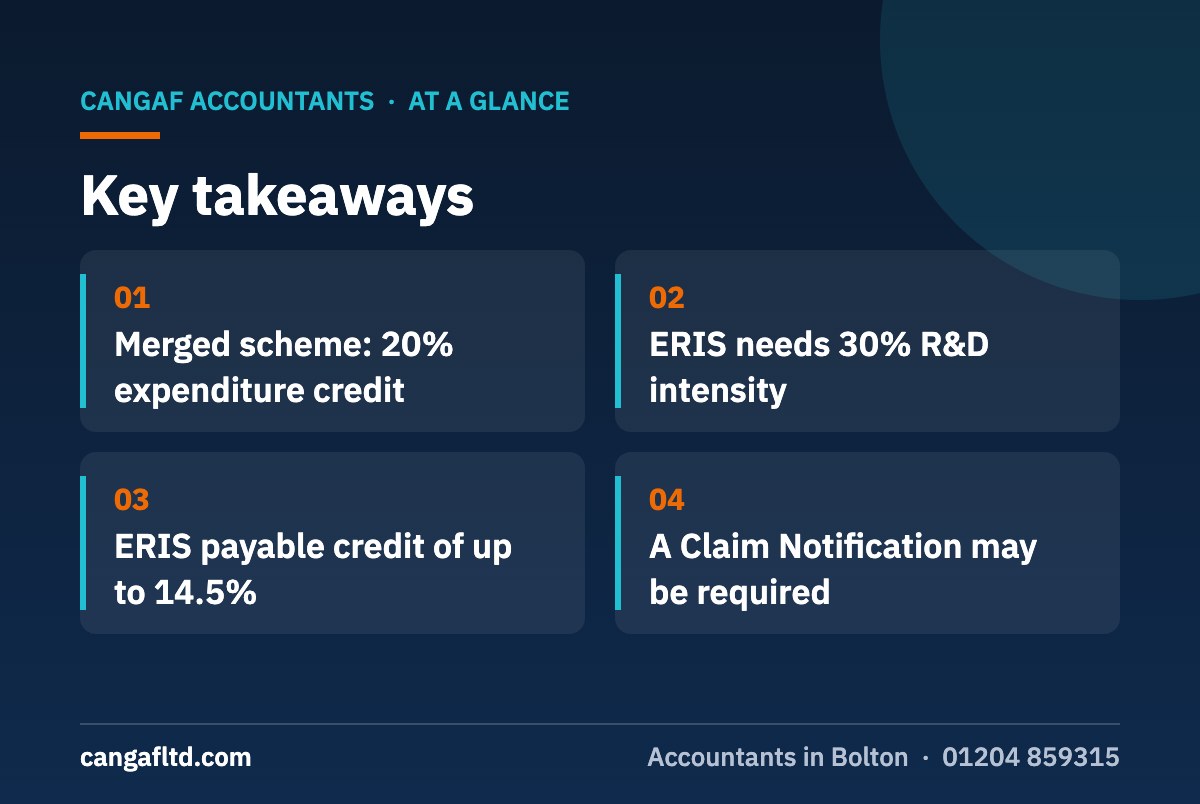
Under the merged scheme, the R&D expenditure credit is generally calculated at 20% of qualifying R&D expenditure for non-ring-fence trades. The credit is taxable as trading income, so the headline percentage should not be treated as a guaranteed cash saving. It interacts with your corporation tax position.
For many businesses, the starting point is therefore no longer “Are we an SME?” It is “Did we actually carry out qualifying R&D, and can we substantiate the costs?“
Does my small business qualify for R&D tax relief?
HMRC looks for qualifying R&D. In simple terms, the project must seek an advance in science or technology and involve scientific or technological uncertainty that cannot readily be resolved by a competent professional in the field.
That can include developing software where the technical challenge goes beyond routine programming. It can also include engineering or manufacturing projects where the business is trying to achieve a technological advance.
Routine product development, cosmetic changes, market research and work based only on established technology do not automatically become R&D because they involved time, money or skilled employees.
That distinction is central to R&D tax relief eligibility.
ERIS: an extra route for R&D-intensive SMEs
ERIS R&D tax relief is aimed at loss-making R&D-intensive SMEs. For accounting periods beginning on or after 1 April 2024, the company generally needs relevant R&D expenditure equal to at least 30% of its total expenditure, including relevant connected-company amounts.
For qualifying claims, ERIS provides an additional 86% deduction. A company may also surrender the relevant loss for a payable tax credit of up to 14.5%, subject to the detailed calculation and PAYE cap.
An R&D-intensive SME can choose between ERIS and the merged scheme, but cannot claim both for the same expenditure.
So, what is the 30% R&D intensity condition? It compares relevant R&D expenditure with total expenditure. It is not simply a test of whether 30% of your employees work on R&D.
What costs qualify under the R&D tax relief merged scheme?
Qualifying expenditure can include relevant staff costs, qualifying externally provided workers, certain contractor costs, consumable items, software, data licences and cloud computing costs. Clinical-trial participant payments can also qualify where the relevant conditions are met.
For example, software development may qualify when the underlying project meets the R&D definition. But buying ordinary software for general business administration does not suddenly become R&D expenditure.
The same applies to employee costs. You can generally claim the relevant proportion of staff costs linked to qualifying R&D work, rather than automatically claiming an employee’s entire salary.
Capital expenditure, land costs and ordinary business costs outside the qualifying categories cannot simply be added to the claim.
What about subcontracted or overseas R&D?
The post-2024 rules changed how contracted-out R&D is considered.
The company that decides R&D needs to be carried out and plans the work will generally be the claimant, subject to the detailed rules. Contracts, project ownership and who made the relevant decisions can therefore matter.
Overseas expenditure also needs careful attention. Certain payments for overseas externally provided workers and contractor R&D are restricted, although HMRC provides specific exceptions.
So, can overseas R&D costs qualify for UK R&D tax relief? Sometimes, but not simply because the overseas work relates to a UK project. The statutory conditions need checking before those costs enter the claim.
Genuine R&D can still produce a weak claim
A technically qualifying project does not guarantee a compliant claim.
Companies can run into trouble with poor project descriptions, weak evidence, unsupported cost allocations or incorrect assumptions about who owns the R&D.
There are also filing requirements. An Additional Information form must be submitted before, or on the same day as, the Company Tax Return. If required, a Claim Notification form must also be submitted within the relevant notification period. Missing the required notification can invalidate the claim.
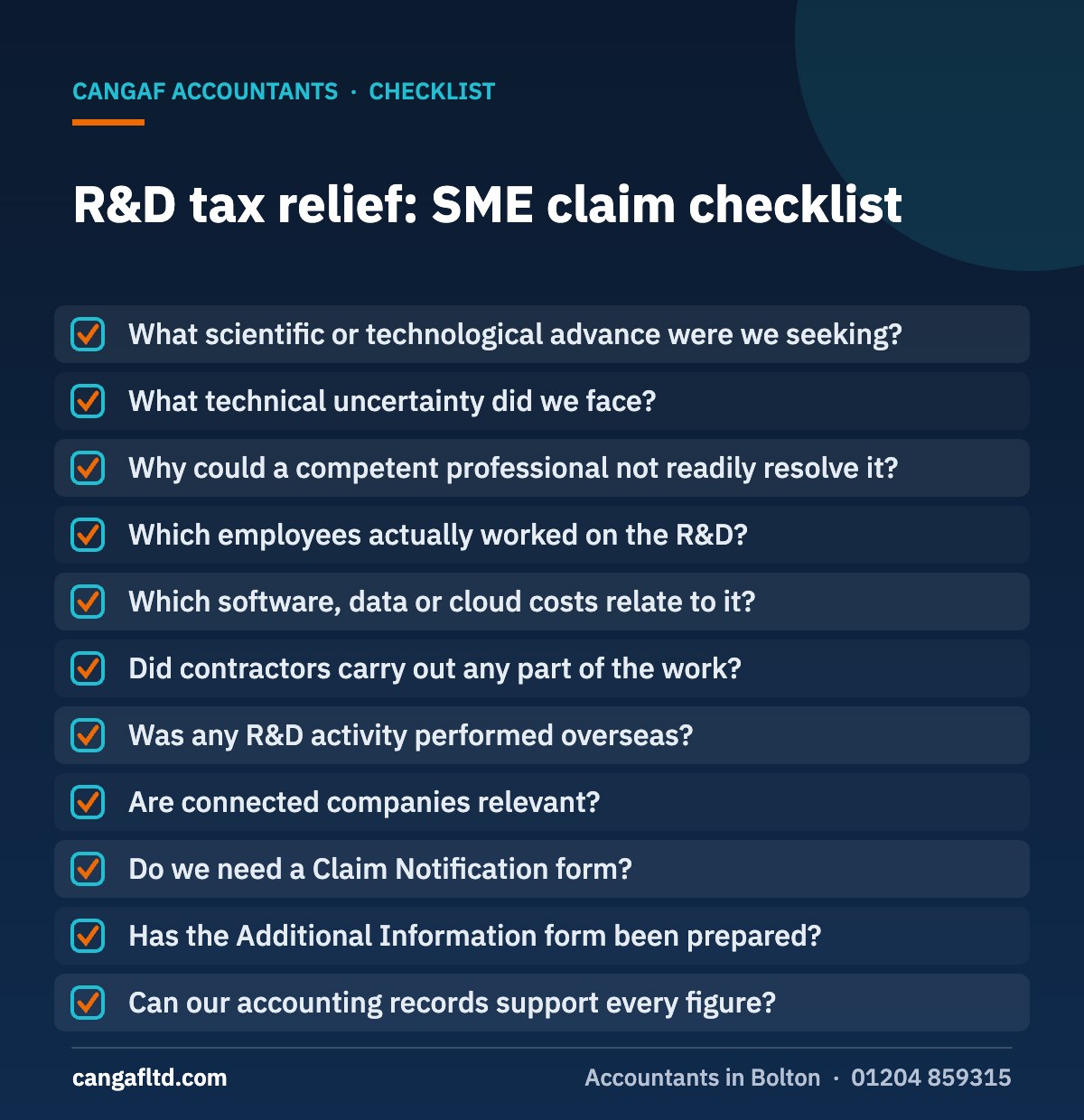
R&D tax relief 2026: a practical SME checklist
Before assuming your company qualifies, ask:
- What scientific or technological advance were we seeking?
- What technical uncertainty did we face?
- Why could a competent professional not readily resolve it?
- Which employees actually worked on the R&D?
- Which software, data or cloud costs relate to it?
- Did contractors carry out any part of the work?
- Was any R&D activity performed overseas?
- Are connected companies relevant?
- Do we need a Claim Notification form?
- Has the Additional Information form been prepared?
- Can our accounting records support every figure?
Looking for other ways to manage your company’s tax? Read how to pay less corporation tax, or see what the Autumn Budget 2026 could mean for business reliefs.
Frequently Asked Questions
Can an SME still claim R&D tax relief after April 2024?
Yes. Eligible companies can claim under the merged scheme, while qualifying loss-making R&D-intensive SMEs may also consider ERIS.
How much R&D tax relief can an SME claim?
Under the merged scheme, the general expenditure credit rate is 20% for non-ring-fence trades. The actual tax outcome depends on the company’s circumstances and the applicable rules.
Can I claim R&D tax relief for software development?
Potentially. Software development can qualify where the project meets HMRC’s R&D definition and the related expenditure falls within the qualifying categories.
Can subcontracted R&D qualify under the merged scheme?
Potentially. The rules depend on who contracted for the R&D, who made the decisions and the nature of the arrangement.
Does my company need to be profitable to claim R&D tax relief?
No. Profitability is not a general requirement for the merged scheme. ERIS, however, specifically applies to qualifying loss-making R&D-intensive SMEs.
Cangaf Accountants can help you review the eligibility, qualifying expenditure and supporting records before an R&D tax claim is prepared.
Fill out our contact form with your queries, or email us directly at [email protected] or call us on 01204 859315.