Self-Assessment Accountants in Wigan: Why Sole Traders and Landlords Choose Local Support Over DIY Filing

Table of Contents
Doing your Self Assessment yourself can seem perfectly reasonable.
Your figures are in. Your bank statements are nearby. HMRC has an online form. How hard could it be?
Then you reach the expense section and start wondering whether that new laptop, mileage, insurance or phone bill actually counts.
That is where the choice between DIY filing and Self Assessment accountants in Wigan becomes more interesting.
The question is not whether you can file alone. You usually can. The question is whether the time, uncertainty and tax decisions involved make professional support worthwhile.
What do Self Assessment accountants in Wigan actually do?
A good Self Assessment accountant does more than press “submit”.
They can review your income and expenses, check your records, calculate your tax position and prepare the return. They can also explain payments on account and help you plan for the bill before the deadline arrives.
For Wigan sole traders and landlords, that can mean having someone to ask when a situation stops being straightforward.
The value depends on your circumstances. A simple return with clean records may be easy to handle yourself. Multiple income sources or property interests can change the picture.
1. They help identify legitimate allowable expenses
This is one area where people often second-guess themselves.
Sole traders can claim allowable business costs when working out taxable profit. HMRC lists categories including business travel, insurance, advertising, professional fees, office costs and certain equipment. Personal spending does not qualify. (See our guide to claiming business travel expenses.)
There are also simplified expenses for some costs, including qualifying vehicle use and working from home.
A tax accountant for sole traders in Wigan can help you understand which method fits your records and circumstances, rather than treating every receipt as automatically claimable.
2. They can help prevent avoidable mistakes
DIY filing becomes less attractive when several things are happening at once.
You might forget a small income source. An expense could be placed in the wrong category. You may misunderstand payments on account or simply enter the wrong figure.
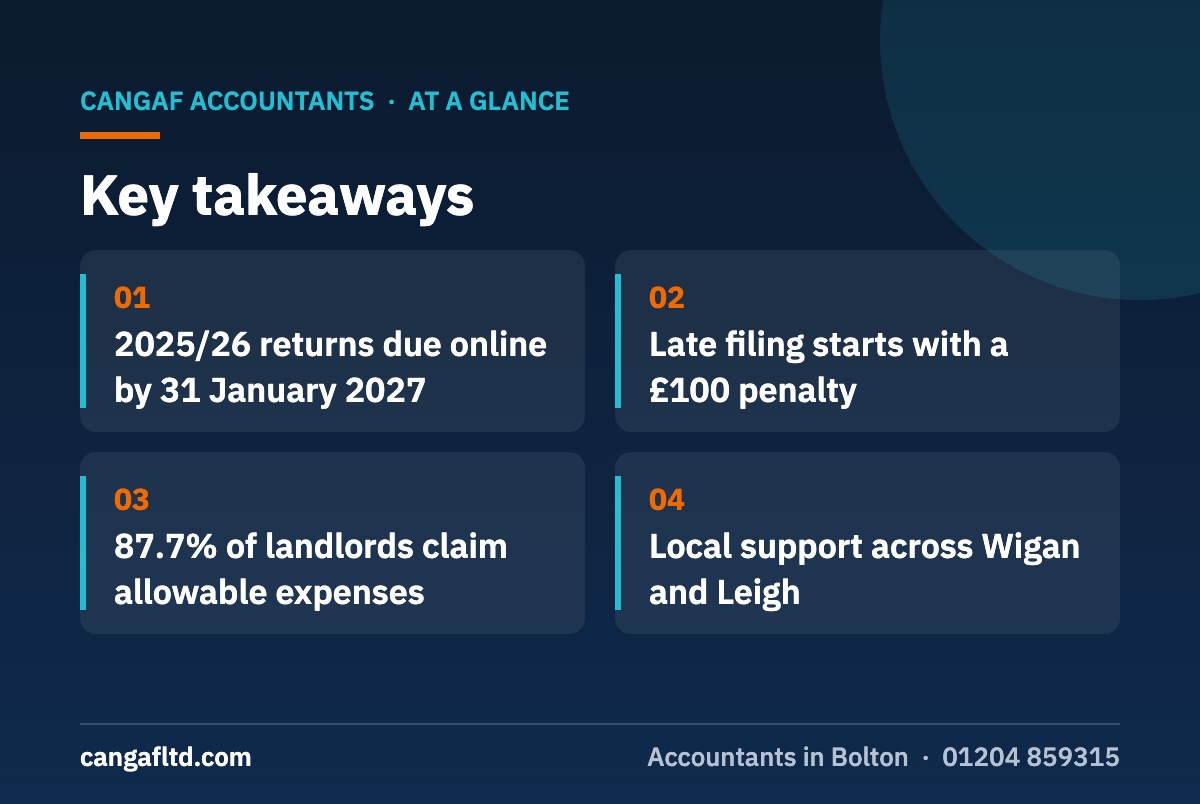
HMRC’s online Self Assessment deadline for the 2025/26 tax return is 31 January 2027. Late returns can attract an initial £100 penalty, followed by further penalties if the delay continues.
3. They make tax bills easier to plan
The unpleasant part of Self Assessment is often not the calculation. It is discovering the bill when you were not expecting it.
Payments on account can make this more important. These are advance payments towards your next tax bill, usually due in two instalments.
For example, suppose your Self Assessment bill is £4,000 and you are required to make payments on account. You may need to budget for the £4,000 balancing payment plus advance payments towards the following year’s liability.
That is why Self Assessment help in Wigan can be useful before filing, rather than only on filing day.
4. Landlords often face extra tax questions
A landlord accountant in Wigan can help you separate rental income from personal money and review expenses such as repairs, insurance, letting-agent fees and certain professional costs.
But repairs and improvements are not the same thing. HMRC generally allows revenue expenses incurred wholly and exclusively for the property business, while capital improvements are treated differently.
Residential landlords also have specific rules for finance costs. Mortgage interest is not simply deducted from rental income in the same way as many other expenses. Landlords can also benefit from self assessment early filing.
HMRC’s latest property statistics show that 87.7% of unincorporated landlords declared some form of allowable expense in 2024/25.
5. Sole traders can get support as the business grows
A first-year freelancer may have a handful of invoices and expenses.
A growing business can have subcontractors, equipment, business mileage, home-working costs, several bank accounts and more income streams.
That is when an accountant for self-employed people in Wigan can become useful beyond the annual return. Bookkeeping, expense tracking and tax planning can become part of a wider financial routine.
Making Tax Digital may also become relevant for qualifying sole traders as the rules expand. Landlords should check whether they are ready for Making Tax Digital.
6. Local support can make communication easier
For someone based in Wigan, Leigh, Atherton, Standish or nearby, local support can have practical advantages.
You may prefer face-to-face meetings. You may want someone who understands how small businesses operate locally. Or you may simply find it easier to pick up the phone and explain a problem.
That does not make a local accountant automatically better than an online firm. Communication, experience and the service you actually receive matter more than the postcode.
Self Assessment accountant vs DIY: which makes sense?
DIY filing may suit you if your records are simple, your income is straightforward and you understand the rules.
Professional support may make more sense if you have:
- Several income sources
- Rental properties
- Complex expenses
- A growing sole-trader business
- Higher or irregular income
- Company or director interests
- Questions about payments on account
- Limited time to manage records
There is no universal answer to “do I need an accountant for Self Assessment?” Our article on why sole traders hire an accountant goes deeper.
How to choose Self Assessment accountants in Wigan
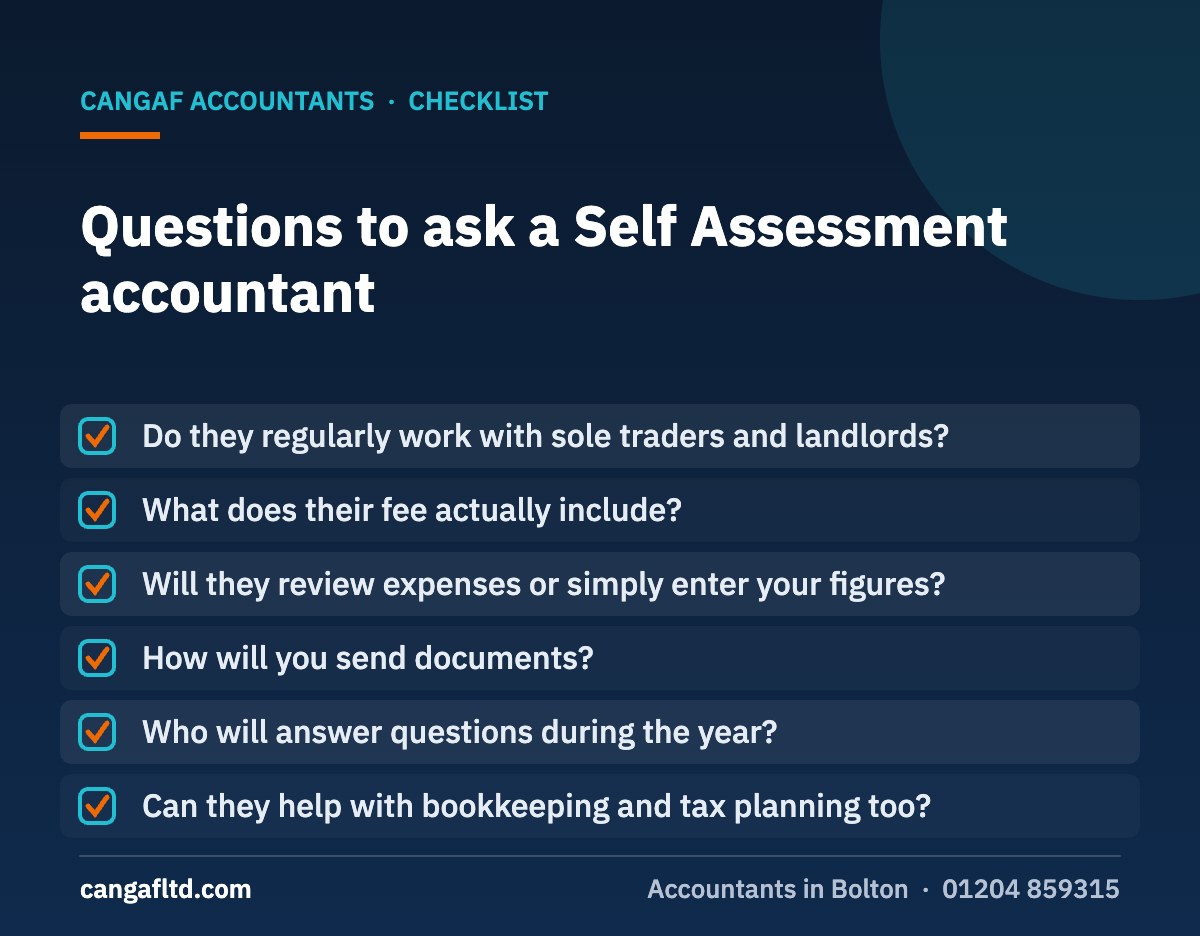
Before hiring anyone, ask:
- Do they regularly work with sole traders and landlords?
- What does their fee actually include?
- Will they review expenses or simply enter your figures?
- How will you send documents?
- Who will answer questions during the year?
- Can they help with bookkeeping and tax planning too?
Also ask how much a Self Assessment accountant costs in Wigan before agreeing to anything. A low headline fee may not include the support you actually need.
Frequently Asked Questions
Do I need an accountant for Self Assessment?
No. You can complete your own return. Professional support becomes more useful as your income, expenses or financial affairs become more complicated.
Can an accountant help with my first Self Assessment tax return?
Yes. An accountant can help you understand what income and expenses need reporting and how to organise your records.
Do landlords need an accountant for Self Assessment?
Not necessarily. But rental income, repairs, improvements and finance costs can make landlord tax returns more involved.
What expenses can landlords claim?
Depending on the circumstances, allowable costs can include repairs, insurance, letting fees, management fees and certain professional costs. Capital improvements are treated differently.
Can an accountant file my Self Assessment tax return?
Yes. An accountant can prepare and submit the return on your behalf when properly authorised to act as your tax agent.
The right support depends on your situation
Choosing between DIY and Self Assessment accountants in Wigan is not about assuming one option is always better.
For Wigan sole traders, landlords and self-employed people who want help with Self Assessment, bookkeeping or tax planning, Cangaf Accountants can discuss what you actually need before you decide. Contact our expert accountants today!